Introduction
Fire safety is one of the most important aspects of protecting commercial buildings, industrial facilities, residential complexes, hospitals, hotels, and other infrastructure. Installing a reliable fire alarm system helps detect potential fire hazards at an early stage, alert occupants, and support faster emergency response.
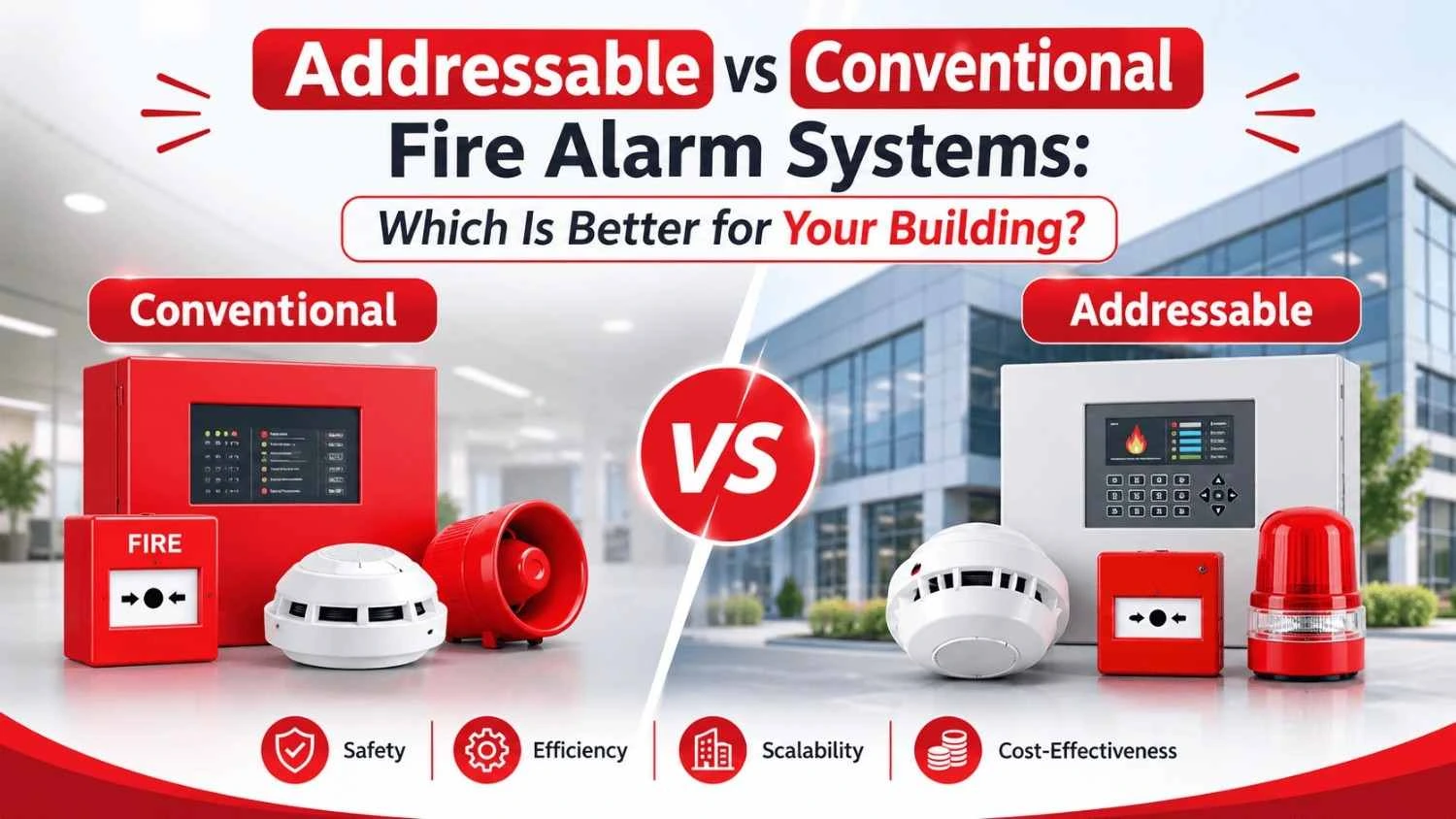
When selecting a fire alarm system, two popular options are Addressable Fire Alarm Systems and Conventional Fire Alarm Systems. Both systems are designed to detect fire-related conditions and provide alerts, but they differ in their technology, detection capabilities, installation requirements, and suitability for different building sizes.
So, which system is better for your building?
In this blog, we will explain the differences between addressable and conventional fire alarm systems, their advantages, limitations, applications, and key factors to consider before choosing the right solution.
What Is an Addressable Fire Alarm System?
An Addressable Fire Alarm System is an advanced fire detection solution in which every connected device, such as smoke detectors, heat detectors, manual call points, and other compatible devices, has a unique identification address.
When a fire-related condition is detected, the fire alarm control panel identifies the specific device or location that has activated the alarm. This allows building management and emergency response teams to identify the affected area more accurately.
Addressable systems are commonly used in large commercial buildings, shopping malls, hospitals, airports, hotels, IT parks, and industrial facilities
Key Features of Addressable Fire Alarm Systems
- Individual Device Identification: Identifies the specific detector or device that triggers an alarm.
- Advanced Monitoring: Provides detailed information about connected field devices.
- Flexible System Configuration: Supports larger installations and complex building layouts.
- Fault Identification: Helps identify device-level faults and wiring issues.
- Scalability: Can support system expansion depending on the control panel’s capacity.
- Integration Capabilities: Compatible systems can integrate with other building safety and automation solutions.
Advantages of Addressable Fire Alarm Systems
- Accurate identification of the fire alarm location.
- Faster identification of activated detectors.
- Improved monitoring and troubleshooting.
- Suitable for large and complex buildings.
- Supports advanced fire safety management.
- Can reduce the time required to locate an alarm condition.
Applications of Addressable Fire Alarm Systems
- Airports and railway stations.
- Shopping malls and commercial complexes.
- Hospitals and healthcare facilities.
- Hotels and hospitality buildings.
- IT parks and corporate offices.
- Manufacturing plants and industrial facilities.
- Large residential and mixed-use developments.
What Is a Conventional Fire Alarm System?
A Conventional Fire Alarm System is a fire detection solution that divides a building into multiple detection zones. Each zone contains connected devices such as smoke detectors, heat detectors, and manual call points.
When a detector activates, the fire alarm control panel identifies the affected zone rather than the exact individual device.
For example, if a smoke detector activates in Zone 2, the control panel indicates an alarm in Zone 2. Building personnel must then inspect that zone to identify the exact detector or location.
Conventional fire alarm systems are generally suitable for small buildings and facilities with simpler layouts.
Key Features of Conventional Fire Alarm Systems
- Zone-Based Detection: Divides the building into multiple detection zones.
- Simple Operation: Easy-to-understand system functionality.
- Cost-Effective Installation: Often has a lower initial investment for smaller buildings.
- Basic Fire Monitoring: Provides alerts when a detector activates within a particular zone.
- Straightforward Maintenance: Suitable for relatively simple installations.
- Small Building Applications: Works well in buildings with limited detection requirements.
Advantages of Conventional Fire Alarm Systems
- Lower initial equipment cost in many small installations.
- Simple installation and operation.
- Suitable for small buildings and independent facilities.
- Easy-to-understand zone-based alarm indication.
- Practical for buildings with straightforward layouts.
Applications of Conventional Fire Alarm Systems
- Small offices.
- Retail shops.
- Small commercial buildings.
- Warehouses with simple layouts.
- Small educational institutions.
- Residential buildings with appropriate system requirements.
Addressable vs Conventional Fire Alarm Systems: Key Differences
Although both systems provide fire detection and alarm functionality, their operating methods and capabilities are different.
Here is a detailed comparison:
| Parameters | Addressable Fire Alarm System | Conventional Fire Alarm System |
| Working Principle | Individual device identification | Zone-based detection |
| Alarm Identification | Identifies the specific device | Identifies the affected zone |
| Technology | Advanced digital communication | Conventional zone circuits |
| Initial Investment | Generally higher | Generally lower |
| Installation | Requires system configuration and addressing | Generally simpler |
| Maintenance | Supports device-level diagnostics | Requires zone-level investigation |
| Fault Monitoring | More detailed device-level information | Generally zone or circuit-level indication |
| Scalability | Suitable for larger and complex systems | More suitable for smaller installations |
| Wiring | Typically uses addressable loops | Uses separate zone circuits |
| Integration | Supports advanced integrations, depending on the panel | More limited, depending on the panel |
| Applications | Large and complex buildings | Small and simple buildings |
Note: Actual system capabilities, wiring arrangements, device limits, and costs depend on the manufacturer, control panel model, project design, and applicable fire safety requirements.
Addressable vs Conventional Fire Alarm Systems: Which Is Better?
There is no single answer for every building. The right choice depends on the building’s size, occupancy, layout, fire safety requirements, budget, and future expansion plans.
1. Choose an Addressable Fire Alarm System If:
An addressable fire alarm system may be the better choice if:
- Your building has multiple floors or large operational areas.
- You need precise identification of the activated detector.
- Your facility requires advanced monitoring and diagnostics.
- You manage a hospital, airport, shopping mall, hotel, or industrial facility.
- You expect future building expansion.
- Your project requires integration with a Building Management System (BMS) or other compatible safety systems.
2. Choose a Conventional Fire Alarm System If:
A conventional fire alarm system may be suitable if:
- Your building is relatively small.
- The layout is simple and easy to divide into detection zones.
- You have limited fire detection requirements.
- Your project budget is limited.
- Zone-level alarm identification is sufficient for your facility.
However, the final selection should always be based on a professional fire safety assessment and applicable regulations.
Factors to Consider Before Selecting a Fire Alarm System
Before investing in a fire alarm system, consider the following important factors:
1. Building Size and Layout
The size, number of floors, room arrangements, and occupancy of your building influence the type of fire alarm system required.
2. Fire Safety Regulations
Ensure that your selected fire alarm system complies with applicable local fire safety regulations, National Building Code (NBC) provisions, relevant BIS standards, and requirements of the local fire authority.
3. Budget and Installation Cost
Consider the initial equipment cost, installation expenses, commissioning, testing, and long-term maintenance requirements.
4. Future Expansion
If you plan to expand your building or add new detection devices in the future, select a system that can accommodate the expected requirements.
5. Maintenance and Technical Support
Regular inspection, testing, preventive maintenance, and timely repair are essential for maintaining fire alarm system reliability.
6. System Integration
For large facilities, consider whether the fire alarm system needs to communicate with compatible BMS, access control, fire suppression, or other emergency management systems.
Why Professional Fire Alarm Installation Matters
Choosing the right fire alarm equipment is only one part of an effective fire safety solution. Proper system design, installation, testing, and commissioning are equally important.
Professional installation helps ensure that:
- Detectors are installed at appropriate locations.
- Fire alarm control panels are configured correctly.
- Wiring and device connections are properly tested.
- Alarm notification devices function as intended.
- The complete system is tested before handover.
- Maintenance requirements are properly documented.
A professionally installed and maintained fire alarm system helps improve building safety and supports reliable fire detection.
Fire Alarm System Installation, Distribution and AMC Services by SLN Automation
SLN Automation India Private Limited provides comprehensive fire safety, security, and automation solutions for commercial, industrial, institutional, and residential projects across India.
Since 2016, we have been delivering turnkey solutions designed to meet different project requirements, with a focus on reliable installation, system integration, and ongoing technical support.
Our fire safety services include:
- Addressable Fire Alarm System Installation.
- Conventional Fire Alarm System Installation.
- Smoke and Heat Detector Installation.
- Fire Alarm Control Panel Installation.
- Manual Call Point Installation.
- Fire Alarm Testing and Commissioning.
- Fire Alarm System Integration.
- Annual Maintenance Contracts (AMC).
- Repair and Maintenance Services.
We work with leading international and Indian fire safety brands, offering solutions based on project specifications and customer requirements.
Why Choose SLN Automation?
- Experienced installation and technical support.
- End-to-end fire safety solutions.
- Distribution of products from leading brands.
- Professional testing and commissioning.
- Annual Maintenance Contracts (AMC).
- 24×7 customer support.
- Services across major cities and locations throughout India.
Whether you require an addressable or conventional fire alarm system, our team can help you identify a suitable solution based on your building requirements.
Conclusion: Which Fire Alarm System Should You Choose?
Both addressable and conventional fire alarm systems play an important role in building fire safety.
A conventional fire alarm system can be a practical solution for smaller buildings with straightforward layouts and zone-based detection requirements. On the other hand, an addressable fire alarm system offers more precise device identification, advanced monitoring, and greater suitability for large and complex facilities.
The best system is the one that meets your building’s fire safety requirements, applicable regulations, operational needs, and future expansion plans.
Looking for reliable fire alarm system installation, distribution, or AMC services in India?
Contact SLN Automation India Pvt. Ltd. for professional fire alarm solutions, installation, testing, commissioning, and maintenance support.
Website: https://slninfosys.com/fire-alarm-system-installation-india/
Phone: +91 90364 15959
Toll-Free: 1800-309-0480
Email: info@slninfosys.com
Frequently Asked Questions (FAQs)
1. What is the main difference between addressable and conventional fire alarm systems?
The main difference is alarm identification. An addressable system identifies the specific device that activates an alarm, whereas a conventional system identifies the affected detection zone.
2. Which fire alarm system is better for commercial buildings?
Addressable fire alarm systems are generally preferred for large commercial buildings because they provide individual device identification and advanced monitoring. Conventional systems may be suitable for smaller commercial properties.
3. Is an addressable fire alarm system more expensive than a conventional system?
Generally, yes. Addressable systems often have higher initial equipment and configuration costs. However, the total project cost depends on building size, device quantity, wiring, installation, and system requirements.
4. Can an addressable fire alarm system be integrated with BMS?
Yes. Many addressable fire alarm systems support integration with Building Management Systems through compatible communication protocols and interfaces. Integration must follow the manufacturer’s specifications and applicable fire safety requirements.
5. Does a fire alarm system require regular maintenance?
Yes. Regular inspection, testing, preventive maintenance, and timely repair are important to ensure that fire alarm devices, control panels, and notification systems remain operational. Annual Maintenance Contracts (AMC) can help manage ongoing maintenance requirements.