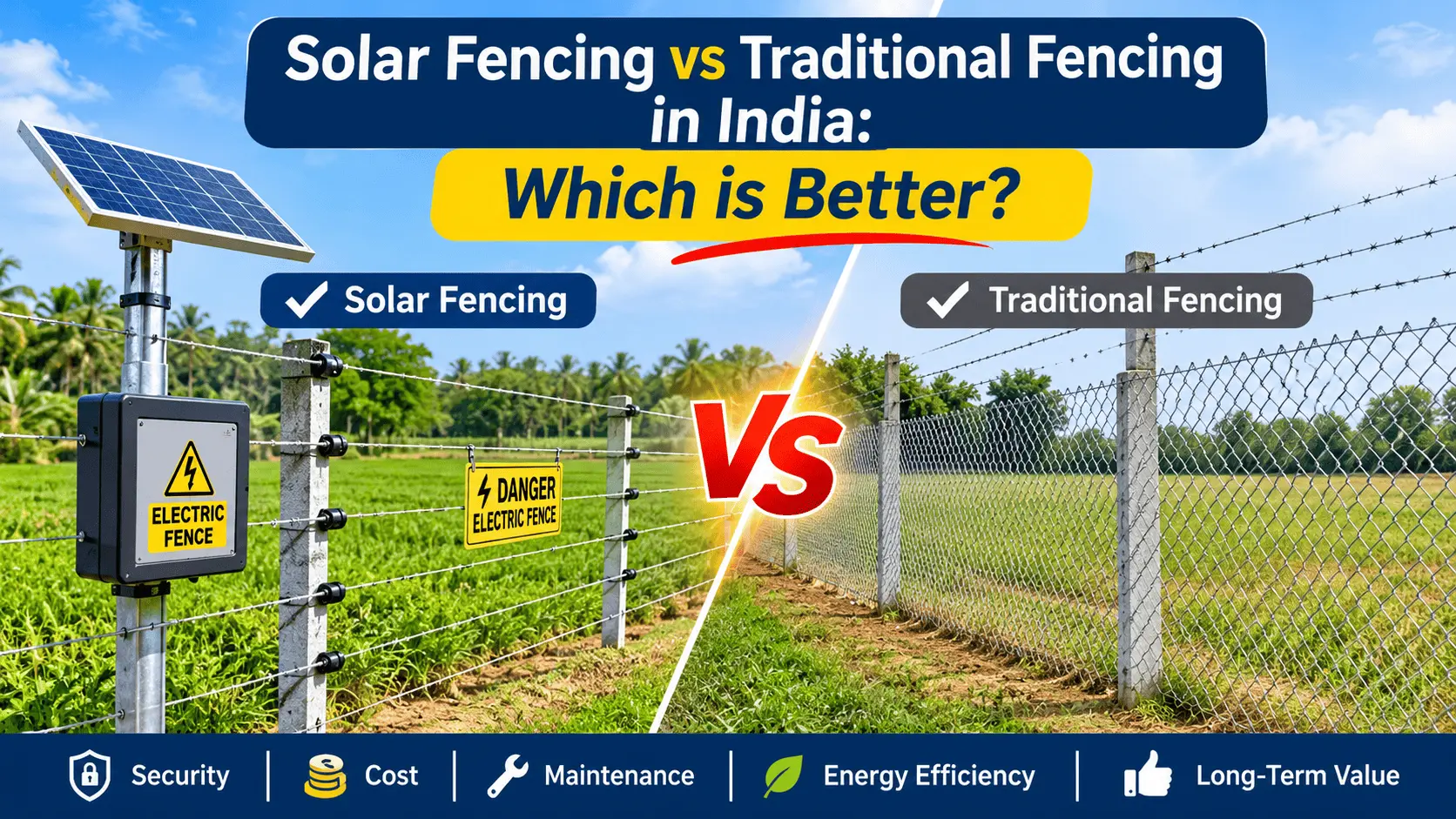
Choosing the right fencing solution is essential for protecting residential properties, commercial buildings, agricultural land, industrial facilities, and large open spaces. In India, traditional fencing has been widely used for decades. However, with increasing security concerns and advancements in technology, solar fencing is becoming a popular alternative.
But which option is better: solar fencing or traditional fencing?
Both solutions offer different advantages depending on your security requirements, property size, budget, and maintenance expectations. In this blog, we will compare solar fencing and traditional fencing to help you make the right decision.
What is Solar Fencing?
Solar fencing is an advanced security system that uses controlled electrical pulses to prevent unauthorized entry into a protected area.
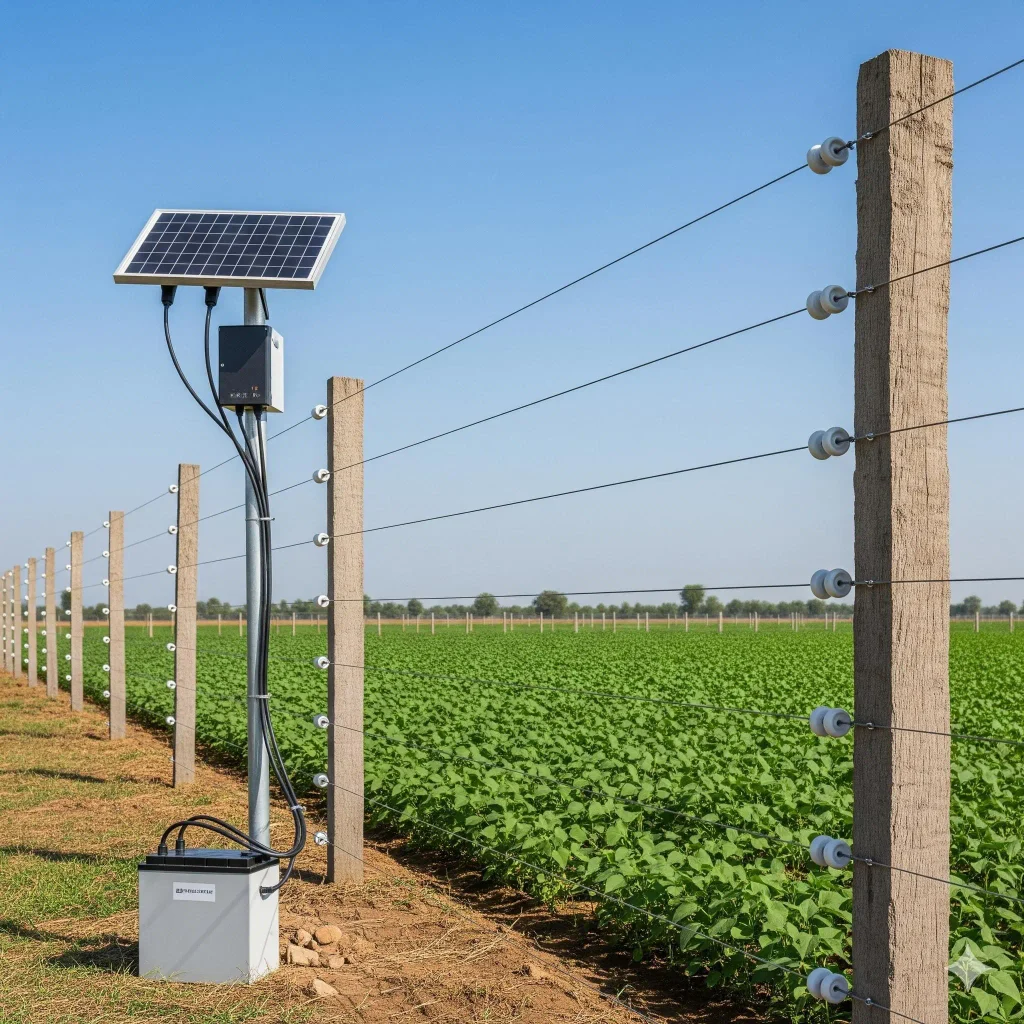
The system generally consists of an energizer, solar panel, rechargeable battery, insulated wires, fence posts, and warning signs.
The solar panel generates electricity, which is stored in a battery and supplied to the energizer. The energizer sends short, high-voltage, low-current pulses through the fencing wires at regular intervals.
When an intruder or animal touches the energized wire, they receive a short electric shock, creating a strong deterrent against trespassing.
Solar fencing is commonly used for:
- Agricultural farms and plantations.
- Residential properties and villas.
- Industrial facilities and warehouses.
- Solar power plants.
- Government and institutional premises.
- Large commercial properties.
What is Traditional Fencing?
Traditional fencing refers to conventional physical barriers installed around a property to restrict access and prevent unauthorized entry.
These fences are available in different materials, including barbed wire, chain-link mesh, welded mesh, concrete walls, and metal fencing.
Unlike solar fencing, traditional fencing primarily relies on physical obstruction rather than an electrical deterrent.
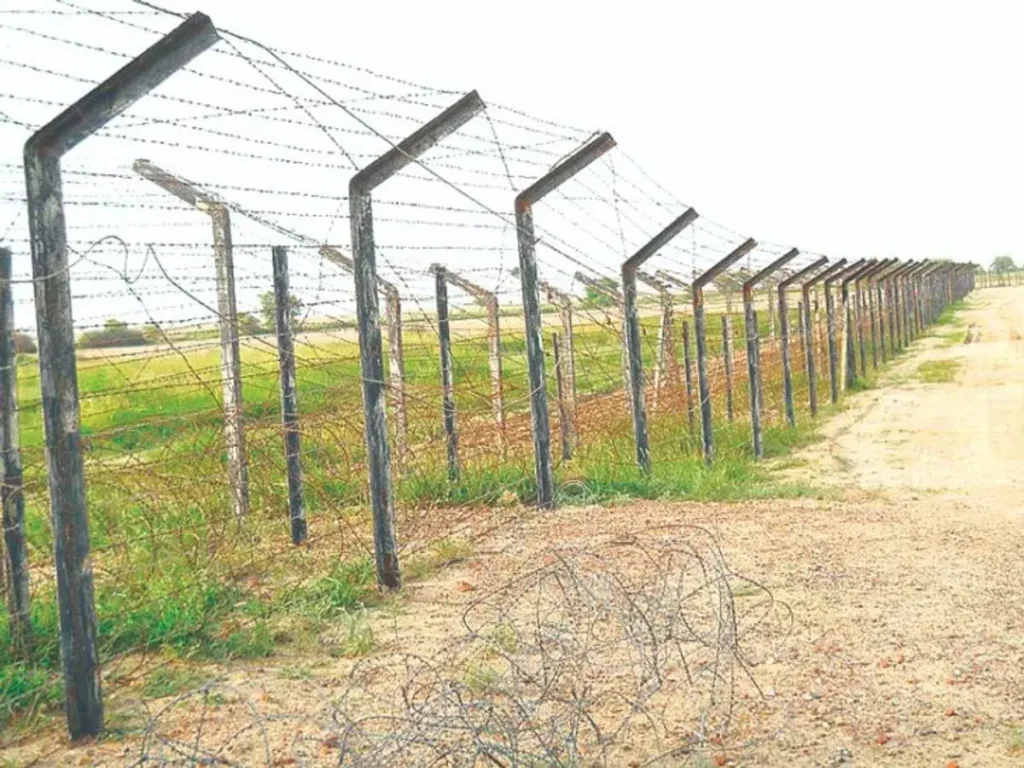
Traditional fencing is commonly used for:
- Residential boundaries.
- Agricultural land.
- Industrial compounds.
- Construction sites.
- Commercial properties.
- Public infrastructure.
Solar Fencing vs Traditional Fencing: Key Differences
Let’s compare both fencing solutions based on important factors.
1. Security and Protection
Solar fencing provides an additional layer of security through controlled electrical pulses. It acts as a deterrent against intruders attempting to climb or cross the fence.
Traditional fencing provides a physical barrier, but certain types of fences can be climbed, cut, or damaged depending on their construction.
Winner: Solar Fencing – When properly installed and maintained, it provides an additional active security deterrent.
2. Installation Cost
Traditional fencing generally has a lower initial installation cost, particularly for basic barbed-wire or chain-link fencing.
Solar fencing requires additional components such as an energizer, solar panel, battery, and specialized installation. Therefore, the initial investment may be higher.
However, the overall cost depends on the property size, fence design, materials, and security requirements.
Winner: Traditional Fencing – Generally more affordable for basic boundary protection.
3. Maintenance Requirements
Traditional fencing may require periodic inspections, painting, rust prevention, replacement of damaged sections, and structural repairs.
Solar fencing requires battery inspections, energizer maintenance, checking wire tension, vegetation management, and periodic system testing.
Both systems require maintenance to ensure long-term performance.
Winner: Depends on the installation – Maintenance requirements vary based on environmental conditions, materials, and system quality.
4. Power Consumption and Energy Efficiency
One of the biggest advantages of solar fencing is its ability to operate using solar energy.
Solar panels charge rechargeable batteries that power the energizer. This makes the system suitable for remote agricultural and industrial locations where grid electricity may not be readily available.
Traditional fencing does not require electricity because it works as a passive physical barrier.
Winner: Solar Fencing – Particularly useful in locations with limited access to electricity.
5. Coverage for Large Areas
Traditional fencing is widely used for enclosing large agricultural fields, industrial land, and residential boundaries.
Solar fencing can also protect large areas and is especially useful for farms, plantations, solar parks, and industrial properties.
The system can be designed according to the site’s perimeter and security requirements.
Winner: Both – The ideal option depends on the property layout and required security level.
6. Long-Term Value
Traditional fencing can be economical initially, but damaged wires, corrosion, and structural repairs may increase maintenance expenses over time.
Solar fencing requires a higher initial investment but provides an additional security deterrent and can reduce dependence on conventional electricity when designed with solar power.
Winner: Solar Fencing – For properties where enhanced security is a priority.
Comparison Table: Solar Fencing vs Traditional Fencing
| Feature | Solar Fencing | Traditional Fencing |
| Security | Active deterrent | Physical barrier |
| Initial investment | Generally higher | Generally lower |
| Electricity | Solar-powered option | Not required |
| Maintenance | Electrical and wire checks | Structural maintenance |
| Intruder deterrence | Electric pulse warning | Physical obstruction |
| Large-area protection | Suitable | Suitable |
| Remote locations | Highly suitable | Suitable |
| Long-term value | Good for enhanced security | Good for basic protection |
Advantages of Solar Fencing in India
Solar fencing offers several benefits, particularly for properties that require reliable perimeter protection.
1. Solar-Powered Operation
Solar fencing can operate using renewable solar energy, making it suitable for remote locations and agricultural properties.
2. Enhanced Perimeter Security
The electrical pulse acts as an additional deterrent against unauthorized entry.
3. Suitable for Agricultural Land
Farm owners can use solar fencing to help prevent trespassing and protect crops from animals, subject to appropriate installation and safety measures.
4. Low Electricity Dependence
A properly designed solar fencing system can operate without continuous dependence on grid electricity.
5. Flexible Installation
Solar fencing can be installed around farms, industrial premises, residential properties, warehouses, and other secured locations.
Limitations of Traditional Fencing
Although traditional fencing remains a reliable boundary protection solution, it has certain limitations.
- Basic fences may be easier to climb or damage.
- Barbed-wire fencing may not provide sufficient security against determined intruders.
- Metal fences can develop rust and corrosion.
- Large properties may require considerable material and installation expenses.
- Traditional fencing does not provide an active electrical deterrent.
However, high-quality physical fencing remains an effective option for properties where basic boundary demarcation and access restriction are the primary requirements.
Which Fencing is Better for Your Property?
The right fencing solution depends on your security requirements.
Choose Solar Fencing If:
- You need enhanced perimeter security.
- You own agricultural land or a large plantation.
- Your property is located in a remote area.
- You want an additional deterrent against unauthorized entry.
- You need a solar-powered security solution.
Choose Traditional Fencing If:
- You need basic boundary protection.
- Your budget is limited.
- You want a simple physical barrier.
- Electrical security is not a requirement.
- You need fencing primarily for property demarcation.
For properties requiring a higher level of protection, combining traditional physical fencing with a properly installed solar fencing system can provide an effective security solution.
Importance of Professional Solar Fencing Installation
Solar fencing is an electrical security system, and its effectiveness depends on proper design, installation, and maintenance.
Professional installation helps ensure:
- Correct energizer selection based on fence length.
- Proper solar panel and battery capacity.
- Secure installation of fencing posts and insulators.
- Correct earthing and electrical connections.
- Appropriate warning signage.
- Compliance with applicable electrical safety requirements.
- Regular inspection and testing of the system.
The system must use a compliant, purpose-built electric fence energizer with controlled pulses. Direct connection to mains electricity is unsafe and must never be used.
Conclusion: Solar Fencing or Traditional Fencing?
Both solar fencing and traditional fencing have their own advantages.
Traditional fencing is a cost-effective solution for basic boundary protection, while solar fencing offers an additional layer of security through controlled electrical pulses and solar-powered operation.
If your priority is enhanced perimeter security, particularly for agricultural land, industrial facilities, commercial properties, and large residential premises, solar fencing can be a worthwhile investment.
Before choosing a solution, evaluate your property size, security risks, installation budget, and long-term maintenance requirements.
Looking for Reliable Solar Fencing Solutions in India?
SLN Automation India Pvt. Ltd. provides security and automation solutions for residential, commercial, agricultural, and industrial applications.
Our solutions include solar fencing, CCTV surveillance, access control systems, fire alarm systems, and other integrated security solutions.
Whether you need perimeter protection for agricultural land, an industrial facility, or a commercial property, our team can help you identify a suitable security solution.
Contact SLN Automation India Pvt. Ltd.
- Website: https://slninfosys.com/solar-fencing-system-installation/
- Toll-Free: 1800-309-0480
- Email: info@slninfosys.com
- Phone: +91 90364 15959
Protect Your Property. Strengthen Your Security with SLN Automation.