What Is a Biometric Access Control System?
A biometric access control system verifies identity using unique biological traits such as:
- Fingerprint
- Face recognition
- Iris or palm vein
Since biometric data is unique to every individual, these systems offer high-level security and eliminate the risk of lost or shared credentials.
Key Benefits of Biometric Access Control
- ✔ Cannot be shared or duplicated
- ✔ Accurate attendance & access tracking
- ✔ High security for restricted areas
- ✔ Ideal for compliance-driven industries
Limitations
- ❌ Higher initial cost
- ❌ May require hygiene considerations
- ❌ Environmental factors can affect sensors
What Is a Card Access Control System?
A card access control system uses RFID cards, proximity cards, or smart cards to grant access. Users simply tap or swipe their card at a reader.
These systems are cost-effective, scalable, and widely used in offices, apartments, hospitals, and commercial buildings.
Key Benefits of Card Access Control
- ✔ Lower upfront cost
- ✔ Easy to issue, replace, and manage
- ✔ Fast access for high-traffic areas
- ✔ Ideal for growing businesses
Limitations
- ❌ Cards can be lost, stolen, or shared
- ❌ Slightly lower security than biometrics
Biometric vs Card Access Control: Feature Comparison
| Feature | Biometric Access Control | Card Access Control |
| Security Level | Very High | Medium to High |
| Credential Sharing | Impossible | Possible |
| Initial Cost | Higher | Lower |
| Maintenance | Moderate | Low |
| User Convenience | High | Very High |
| Scalability | Medium | High |
| Attendance Accuracy | Excellent | Good |
Which Access Control System Is Best for Your Business?
Choose Biometric Access Control if:
- You need maximum security
- Attendance accuracy is critical
- You operate in IT parks, factories, data centers, banks
- You want to prevent proxy attendance
Choose Card Access Control if:
- You want a budget-friendly solution
- Your organization is growing
- You manage offices, hospitals, schools, apartments
- You need easy scalability and quick access
👉 Pro Tip: Many businesses now use hybrid systems (Biometric + Card) for flexibility and backup access.
Cost Consideration: Biometric vs Card Access Control
- Biometric System Cost: Higher device cost but lower risk of misuse
- Card System Cost: Lower installation cost but recurring card replacement cost
The right choice depends on security needs, employee strength, and budget.
Why Choose Us for Access Control System Installation?
We provide end-to-end Access Control Solutions across India, including:
- ✅ Site survey & system design
- ✅ Biometric & Card Access Control installation
- ✅ Enterprise & commercial-grade hardware
- ✅ Integration with CCTV, Fire Alarm & Attendance
- ✅ Annual Maintenance Contracts (AMC)
- ✅ 24×7 customer support
Our solutions are customized for offices, factories, warehouses, hospitals, IT parks, and commercial buildings.
Frequently Asked Questions (FAQs)
-
Is biometric access control more secure than card access control?
Yes. Biometric systems offer higher security because biometric data cannot be shared or duplicated.
-
Which access control system is better for offices?
For small to mid-sized offices, card access control is cost-effective. For high-security offices, biometric systems are better.
-
Can biometric and card access control work together?
Yes. Hybrid systems combining biometric and card access are commonly used.
-
What happens if a biometric device fails?
Most systems include backup options like cards, PINs, or mobile access.
-
Do you provide AMC for access control systems?
Yes, we offer Annual Maintenance Contracts (AMC) and 24×7 technical support.
Final Verdict: Biometric or Card Access Control?
There is no one-size-fits-all solution.
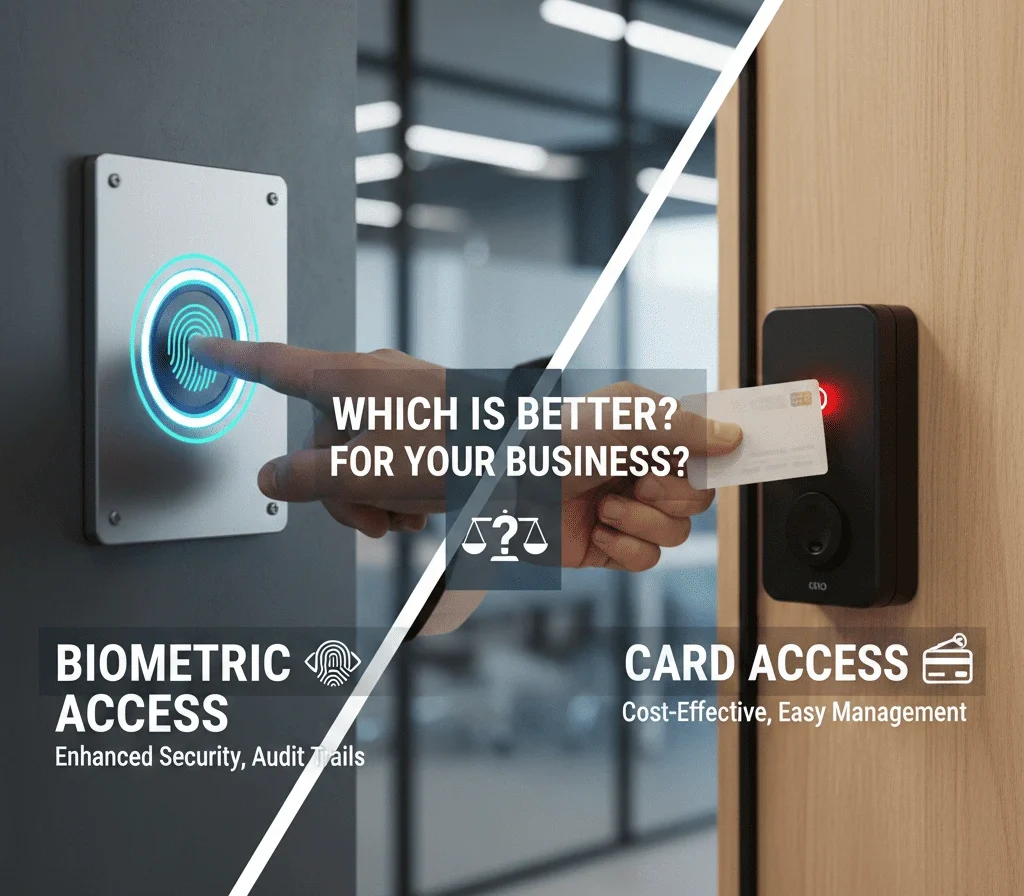
- Biometric Access Control = Higher security & accuracy
- Card Access Control = Cost-effective & scalable
The best choice depends on your security goals, budget, and business type.
📞 Need help choosing the right access control system?
Contact us today for a free consultation and site assessment.